
(originally posted March 10, 2010)
 I first met Jim Ortega when Carlisle hired him to work at her green cement table in the dragonfly portion of Studio Barndiva. I didn’t like that he never said hello or smiled when customers entered and as he was the first person they saw I worried it was affecting our new, struggling business. When our chef Jaime Dillon asked if he could work as a commis in the Barndiva kitchen, as they were roommates and the job with Dragonfly had come to an end, I don’t know why I agreed, but I’m so thankful now that I did. The Jim I came to know during his brief tenure at Barndiva was shy, not indifferent. He was hard working, diligent, soft spoken and very kind. He never let us down. While he talked then of plans to pursue baking as a career, I lost track of him, and we will never know now what he would have ended up doing with his life. The day we arrived in New York Isabel got a call from a close friend to tell her Jim had died, another victim of Sonoma County’s deadly love affair with driving while drunk. I have lived through some pretty rough times in some pretty edgy places but I have never living in a place where so many young people die so stupidly, and needlessly. They drink, ok, I get that, and they live far apart so sometimes they drive, I even get that (though I don’t condone it). What I don’t understand is why they don’t take better care of each other. Jim was a passenger in the car that flipped on a dark winding road to Graton, taking him out but leaving his driver, a “friend,” with a lifetime of guilt. He leaves wonderful parents whose love for him was truly remarkable. And he leaves us all wondering what he would have made of his life, had he lived it. This has got to stop. If anyone out there has a good, effective idea to raise the consciousness that will prevent DUI’s in our community, let us know. We will help you in any way we can. RIP Jimmy.
(originally posted April 21, 2010) At a bend in Hwy 1, a mile before the bar at Rocky Point where they will serve you Red Hook in a perfectly chilled glass, there is a long pullout beneath a row of Cypress that marks the trailhead of Garrapata State Park. On a clear day the vista out over the ocean on this part of the road to Big Sur is sublime. But while it may feel counterintuitive to turn your back on the undulating hills that fall gently down to the sea, rare pleasure awaits you.

Cross the Hwy and follow the path past an old tin shed, which will bring you into an open sage brush chaparral that marks the beginning of the Rocky Ridge and Soberanes Canyon loop. The ocean will be for the rest of the year, but these rain drenched meadows, with their profusion of spring wildflowers that gently climb to ancient redwood groves banked by carpets of wild sorrel will be gone by the end of May.
 I am walking the trail this extraordinary spring day with two women I have known and loved for most of my life ~ one is an artist whose work I have come to Carmel to bring back to Studio Barndiva; the other a botanist who has made study of native plants a focus the last ten years of her life. While not a complete idiot when it comes to native plants (though close) the abundance of flora makes me feel as if I have arrived at a really great party to be suddenly surrounded by incredibly beautiful people whose names I do not know. I want to know all of them. At my prompting my friend starts to reel off a rhythmical litany of plant names as if she had swallowed the Jepson Manual: yellow bush lupine, Indian paintbrush, lotus, ceanothus, woodland star, blue-eyed grass, yerba buena, skullcap, morning glory, monkey flower, owl cover maidenhair ~ listening as we walk it strikes me that most of us live and die without any real knowledge of the native plants that surround us.
 We ford Soberanes Creek and begin to climb a staircase of redwood treads embedded in the side of the mountain. They stop, start again, then disappear completely as we progress along the narrow path now 20' above the rocky fulminating creek. Between the overgrown vegetation, the sun slaking through the trees and the sound of rushing water, I have a sudden déjà vu of another walk I took oh so many years ago through the jungle of Tikal.
One still had the sense in those early days after the discovery of the great Pre- Columbian Mayan city of pulling back an ancient green veil on a civilization that had completely vanished from the earth. Many of the temples were only half uncovered; climbing them you would suddenly find a thick vine the only thing keeping you from a perilous drop into the dense stone covered forest below.
In no way would I compare a hike in Garrapata, where we've just passed a shirtless guy in a Raiders cap, with exploring the ruins in Tikal, where I came upon a Jaguar early one mist heavy morning. But unless something is done in the next ten years to counter the effects catastrophic cut backs have had on our state and national parks, it won't take long before the trails through the forest here in Garrapata, the public trails in every natural woodland across our great state, will ultimately disappear. The forest does not wait to reclaim it's own back.
 At the start of the recession I was not surprised to hear that Hendy Woods State Park, which sits on the Navarro River just below our farm, would be closed for camping for the foreseeable future. I remember thinking ok, if money must be reserved for more essential services, so be it. Yet I also remember thinking how shortsighted the closures were. Here we are telling families to pull in their belts and get ready for a rough ride financially, then closing the public campgrounds ~ beautiful and affordable places they could bring their families. Public campgrounds and maintained trailheads are essential if we hope to teach the next generation how important it is to protect our wild lands. Is this what Arnold really meant by Hasta la Vista Baby?

The truth is, we are not born with habits like hiking and camping. Great hikers usually had parents, grandparents (or great friends) who shared that experience with them when they were young. Almost always it provided a defining encounter they never forgot, and have longed ever since to recover. As to the fundamental importance of a parks system that builds a collective national experience, if you haven’t seen Ken Burns’ ‘The National Parks ~ America’s Best Idea,’ I urge you to so ~ it is an incredible series. Besides rightly reinstating Teddy Roosevelt to the great domestic presidents club, it also makes a compelling argument that as significant as cities were to the development of the American character, our indomitable spirit as a country of great ideas began in the great outdoors.
Like most everything else in life we need to make time to explore them. Plunge off a back road with someone you love this spring ~ mind the poison oak ~ and explore forest trails or chaparrals while they are in their glory. Hiking is free. It will replenish your soul. It’s that rare experience that is convivial yet satisfies a solitary longing.

The night before our walk my friend the painter and I had ended up at the ocean at sunset with hundreds of other folks. The scene was incredibly mellow ~ we were at the end of the first warm spring day, two old friends bantering back and forth as dogs barked, lovers canoodled and little children ran through the breaking waves screaming with joy. On the way back to the car in the failing light, I took a shot of shoe prints in the fine white sand because I liked the patterns they made ~ they seemed extra meaningful as we had been talking at length about a series she was doing for the Studio inspired by the cave paintings of Lascaux.
Looking at that shot now, however, the memory of my forest walk still fresh in my mind, another thought occurs to me. What seemed so distinct through the lens of my camera, what I was able to capture for posterity, was actually incredibly fragile. It would be long gone by morning, blown away, or walked over by new feet carrying lovers to the edge of the sea.

If you ever had trouble answering the age old philosophical question “If a tree falls in a forest and no one is around to hear it, does it make a sound?” try taking it out of the metaphysical realm for a moment, think about it socially, and emotionally, and reconsider your answer. Then go find your boots.
Links to: Garrapata Trail Lake Sonoma trail Jepson Manual Ken Burns The National Parks ~ America’s Best Idea Hendy Woods

Originally posted May 19, 2010)

When life at the Barn gets too intense, which it has a built-in tendency to do, I walk down Center Street to the Plaza and plunk myself down on a bench. I highly recommend it ~ find a bench, ostensibly with a view of something that has its feet firmly planted in the earth, and just sit. After a half-hour of seemingly doing nothing, you will find your personal universe begin to shift ever so slightly.
Sometimes I think great thoughts, but mostly I don’t, I’m alone with them no matter how mundane they are. Our thoughts are like our children, we always seek some redeeming feature in them. For physical health a run would probably be a better option, for speedy energy a shot of caffeine, but for an instant and refreshing change in perspective very few things beat a park bench.

he secret to this particular form of self-medicating is to leave your cell phone ~ blackberry, ipod, laptop, singly or in any combination ~ behind. This is not as easy as it may sound. We all appear to be increasingly addicted to our techno toys, more than we care to admit. Sitting on the bench this week I counted, in the first 50 people who ambled by on their own, 34 who were walking while texting, talking, or listening to something other than the birds in the trees. This was not even counting the groups of people in which someone seemingly “in” the group was simultaneously engaged in a conversation with someone not even there. We go on and on about how little quality time we are able to find in our oversubscribed lives; where once the mantra for our culture was ‘knowledge is power’, now we moan and groan about ‘too much information.’ Why then, do we find it so hard to turn off convergent technology? We are sensible people, right? Where does this insatiable desire to be connected ALL THE TIME at the expense of our and everyone else’s privacy ~ and perhaps our sanity ~ come from?
My first thought sitting on the bench was that digital social mediums wire directly into the part of our brains that bows to a social hierarchy where not much has changed since High School ~ if you aren’t in, you are out. Nobody wants to be left out. The rise of twitching twittering facebook communities seems to support this theory ~ digital popularity as the new religion, documentation of even the smallest details of our lives, as the new confession.
But I had another thought a few hours later, as I watched a man leave the warm and beautiful dining room in Barndiva to go outside in the rain to reply to a text, despite the candlelight, the music and what seemed like an engaging conversation he was having with his girlfriend and another couple. Perhaps our fear of ‘turning off’ rises from a deeper genetic imperative, an urge to know what’s coming before it arrives. Digital Media is our Paul Revere: if we listen closely we will have time to lock the doors and gather the muskets. Or maybe it goes back further still, all the way to our cave dwelling ancestors, where “knowledge is power” really did mean the difference between life and death. You eat the bear or the bear eats you.
In which case this unquenchable desire for information is a rather cool, if subconscious, form of self-protection. The question then becomes, protection from what? What, in modern times, is the bear?
 Probably the same thing it’s always been, (when it wasn’t an actual bear), we are, deep down, desperately afraid we’re living unexamined lives and that we will die without ever figuring out what the point was. But trying to find out what the point is, much less finding a point worth living for is an increasingly quixotic challenge. We exist in a world where global warming is touted as a myth, Sarah Palin is considered sartorial, Monsanto “helps farmers learn to be sustainable,” and the oil slick soaking the coastlines on one of the most fragile ecosystems in the world, is, according to a “pre-eminent” scientists quoted in The New York Times, “not as bad as you think.” We live in a world where verifiable truth is taking a beating ~ let's face it ladies and gentlemen, truth gets the shit beat out of it every day. Which makes it awfully hard to follow the real storyline of history anymore, much less how our lives might intersect, and even be reflected, in it.
 I get all that. What is deeply worrying is that instead of shifting our search for insight elsewhere, using these astonishing media tools and outlets to develop critical wherewithal, we choose to drop the pro and dity in the search for profundity and just go all out for FUN. It's fun to document the minutiae of our lives, and if anyone laughs at us, so what? We, in turn, through the wonders of tweets, facebook, youtube, twiddish, etc. are laughing at them as well. As for traditional ports of call ~ Art, Film, Music ~ where we once sought and found meaningful narratives that reflected a whole range of human values, the work that now gets produced has become, by and large, contrived product placements in-filled with perishable and disposable information. We are manipulated, pandered to, and infantilized from virtually every medium where sales, not enlightment, is the driving force.
 Of course Will Shakespeare wanted people to attend his plays as a testament to his genius, but can we assume he didn’t need product placement to get the bard mojo working? If Jean Luc Godard had to track first day ticket sales, would the French New Wave have survived? Where are the Van Goghs and the John Coltranes, who never made a dime out of painting or playing their hearts out? As Thomas Wolfe knew (another example of a crazy art for arts sake guy) you can’t go home again. But where, exactly, are we going?
If everything we are and everything we love, need, and desire, issues from a personal set of values that can only start its engines when our eyes or our ears engage, it's probably a good idea to take a critical look from time to time at how we form those values, what feeds them, and, crucially, what we need to do to keep them humming. When we lose control of the intricate plot of our lives, even for a little while, we lose the linkages that connect one thing to another ~ before you know it you are inside the mouth of the bear.

The great photographer Henri Cartier-Bresson believed “There is nothing in this world that does not have a decisive moment." By decisive he meant personally verifiable. Bresson wasn’t out to prove things only happen because we see them, but that with patience and perception human beings have the power to visually organize the world so it fits a pattern that means something, and from that pattern a blueprint for living can emerge.
Two years after the second World War ended, when Bresson was, in his own words, “completely lost,” he threw in with fellow photographers George Rodger, Robert Capa and David “Chim” Seymour” to found Magnum, “ a community of thought, a shared human quality, a curiosity about what is going on in the world, a respect for what is going on and a desire to transcribe it visually."
 It seems to me, even If you never pick up a camera, that these are words to live by today ~ curiosity and respect for and about the human condition, fueled by a desire to create a community of thought based upon shared human values. Decisive moments occur in all of our lives, you don’t need to be a Magnum photographer to find them. You do need the time to look and process, in your own mind, the meaning of what you see. You need time to find the artists out there who are still committed to telling a human story of struggle, for only in that kind of story will we also discover the tools to survive.
 The technological sensory overload we all suffer from does not encourage this process. Just having more information at our fingertips does not make us smarter. And we need to get smarter, really fast, because what all our wonderful social media and popular entertainments aren’t telling us is that the bear is gaining.
 RESOURCES
Museums, libraries and bookshops with more re-prints than top sellers are still the best places to experience art that has transforming powers.
Dance and Opera are two art forms which, for very different reasons, have both proved artistically resilient and deserve your patronage. Both are great value (Opera only if you watch it via satellite feed).
RESOURCES
Museums, libraries and bookshops with more re-prints than top sellers are still the best places to experience art that has transforming powers.
Dance and Opera are two art forms which, for very different reasons, have both proved artistically resilient and deserve your patronage. Both are great value (Opera only if you watch it via satellite feed).
To watch great cinema, which is still being made (but you won’t find at your local 12 plex) check out www.filmmovement.com. Not a bad film in the bunch, join or risk them being checked out at Blockbuster.
To hear stimulating music and life affirming conversation, check out programs offered at the Herbst Theatre, especially the City Arts and Lectures Series. One of the best nights I had last year was sitting with Geoff and Lukka, listening to Wendell Berry talking with Michael Pollen. Two human beings sitting on a stage just having a chat and it was riveting. How about that? I missed Frank Rich and Mark Danner in April and I’m still kicking myself.
Intersection 5M- a satellite art space, screening room, and event space in SF worth keeping track of. 5M features local exhibitions focused around arts for change. The inaugural gallery exhibit includes our friend Laura Parker: Let's Talk of a System

(originally posted May 12, 2010)

Thou art thy mother's glass, and she in thee ~William Shakespeare

From all of us at Barndiva, we want to thank the beautiful women who graced our dining rooms with their babies, young children, grown children and grandchildren...
 The Barndiva Lounge and the Gallery Diningroom were overflowing with Dragonfly roses, knowing looks, delightful banter and genuinely smiling faces.

 Thank you for entrusting us with your Mother's Day celebration.


(originally posted May 5, 2010)
A few weeks ago, on the first real day of Spring, we co-hosted a baby shower in the  Barndiva gardens for good friends of ours. I was busy shooting in the kitchen for most of it, but every now and then I gazed out the window to enjoy the laughter rising from the long table we'd set beneath the still bare mulberry trees. Four other women at the party ~ all from Healdsburg ~ were pregnant as well. We are experiencing a veritable baby boom here in our little town. At the end of the afternoon the expectant mother gave everyone small beeswax candles that we were told to light when she went into labor. It was a thoughtful gift from a beautiful young woman about to become a new mother.
Seeing the candle on the counter a few days later, however, triggered a complex of emotions. I'd just come from a meeting with Chef about our Mother's Day menu, which is probably why I paused to consider the rapid progression my thoughts took when I looked at the candle. In the span of a few seconds I managed to move from 'all warm and fuzzy' ~ envisioning a magic circle of friends all spread out across town in our candlelit rooms, by virtue of our collective energy becoming a force field of positivity unto ourselves, to 'self involved' ~ what if no one called to tell me she'd gone into labor, I'd be left out of the magic circle, to 'worried' ~ what if her labor was a long one and the candle didn't last through the birth?
Sanguine to controlling to fearful ~ this is my MO when it comes to motherhood in general. Since the day after my first child was born and the miracle of oxytocin had not worn off, until yesterday, when I spoke to youngest, in college 6,000 miles away, I go through the same personal zeitgeist: from happiness (to hear their voices) to suspicion (what do they want/need) to dread (are they ok? Is something wrong? What's happened?). I usually get back to happiness when they aren't around ~ thankfully love is my default setting with all three of them ~ but honest to God, nothing has ever screwed with my head like being a mother.
 Fascinating subject, motherlove. And skewed quite differently depending upon whether we look at it from the viewpoint of the child, or the mother. I’ve been both and find the second half of the equation ~ being a parent ~ infinitely more fraught, if only because of the power it conveys which you are obligated to administer during their formative years. Being a parent is an early Bob Dylan song that you want to make wonderful sense out of, but ultimately mystifies you. Perhaps because I have the feeling I’ll never get it right, or that there is no right, or that what’s right one minute is capable of being turned on its head the next. And what’s really interesting (bordering on unsettling) is the fact that while we all seem to approach parenting with our own unique set of skills and expectations, at the end of the day there is a startling verisimilitude to motherhood, a DNA set of emotions that is able to transverse both culture and history. It seems to be rooted in the unlimited potential for nirvana or disaster our children’s very existence brings to bear ~ which always lies just beneath the surface.

As to being the child, while not confusing (you have after all, someone to blame or thank outside of yourself) it is infinitely more complex, capable of building your character, or destroying it. Whether you believe in what Freud called the "unshakable optimism" of knowing you are loved despite your faults, or lean more toward Sylvia Plath's visceral underbelly of "you are always there,
tremulous breath at the end of my line, curve of water upleaping,
to my water rod, dazzling and grateful, touching and sucking,” motherlove, or lack of it, is the one true thing we really never get away from. Besides death.
Here’s my theory: If you’re very lucky in life, you get the mother you need, the one that makes you believe in yourself, but also never ceases to kick you in the ass when you need it most. But even if you aren’t lucky, and get an indifferent one, or dreadfully unlucky and get the awful abusive kind, chances are you will never really give up wanting her to be a mother of the first order, the one who truly loves you. That singular focus of attention is kismet to our souls from the moment we are born, controlling to a large extent our perception of ourselves, a divining force in molding our temperament. Live with it.
Picasso, who used his mother’s name throughout his life, depicted the relationship in the painting First Steps as one of interconnecting power surges, an impossible geometry that fights against itself, yet in its unnatural construction manages to be wholly organic. Berthe Morisot, on the other hand, painted as if she accepted the planned obsolescence whereby success can only be achieved when the child no longer needs the mother. The queen is dead. Long live the queen.
The first time I saw Berthe Morisot and Her Daughter Julie Manet, I related to the transitional use of color ~ the steely gray of the mother’s hair seemed to pour into the daughter’s dress, turning it a luminescent blue ~ a life affirming color. Looking at the same painting now, I can clearly see what I missed: the figure of the mother has had the life sucked out of her! The innocence of the daughters direct gaze does not negate her rising dominance over the smaller older woman, whose stare is in stasis, the heavy folds of her dress rooting her to the foreground, pulling her downward. And what’s with the colorless hand that looks like a cadaver’s? How had I missed that before? Perhaps because I was not yet a mother when I first viewed the painting.
Thankfully, my own experience does not jive with Morisot’s (in this work.) While there have been plenty of times I felt the rigors of parenting sucking the air out of the room, my children have more often than not been the only thing which kept me going long after I wanted to quit. Not because of their belief in me ~ I’m one of the lucky ones who thankfully did have a mother to do that ~ but, quite simply, because they make me laugh. We share the same sense of humor. When we are all together and the stars align we are capable of creating that rarest of human communities: a family that speaks the same language, shares the same values (most of which came from previous generations), trades in goodwill, and draws its strength from a deep well of loyalty. It's not always easy to get there however. Sometimes the stupidest things can derail our best intentions. While some families seen to get there by just hanging out, I suspect most of us have to work really hard at it.
When I was at ULCA as an undergraduate I took a seminar with the great L.A. Times book critic Robert Kirsch. Walking to class one day we got to talking about family and he dropped into the conversation, quite casually, that while he had more than one child, he really only liked one of them. How can you not like your kids, I asked, shocked to the core. You have to love them, he replied, there’s nothing written you have to like them. And, he added, if you make that a condition of your love, you saddle them with not being free to find out who they really are, without the judgment of whom you expect them to be constantly hanging over them. They are their own people, or should be, he concluded, and at the end of the day that’s what you need them to be. His use of the word ‘need’ instead of ‘want’ wasn’t intended to be pejorative, but empowering. Kirsch was very careful with language. I took note.
A lot has been said about the commercialization of Mothers Day that I agree with, but in the end I think it’s a wonderful opportunity that should not be lost, a chance to say thank you to someone who gave you life and, by hook or by crook, whether for a moment or a lifetime, had a hand in keeping you alive. Whether you actually say I love you or just pass the ketchup doesn’t matter. So long as you don’t use the time to settle old grudges or try and change the family dynamic, there is joy to be found in the quiet moments of time just spent together, especially if you listen to them echo. There is truth~ if not god~ to be found in the details, because details are what ultimately define us. Not the grand gesture, but a touch, a conversation, a knowing look. And hey, in case you need it said out loud, this holds true even if your mother is physically gone now, like mine. That’s the beauty of this profound connection. I spoke to my mum just this morning. Good thing, too. She told me not to get too heavy on the Freud.
There is a wonderful poem by Shamus Heaney that ends
So while the parish priest at her beside Went hammer and tongs at the prayers for the dying, And some were responding and some were crying, I remembered her head bent towards my head, Her breath in mine, our fluent dipping knives Never closer the whole rest of our lives


(originally posted April 28, 2010)

The mid-60’s were pretty heady times to grow up in LA, especially for a teenager on the prowl with a fake ID and somebody’s parents borrowed car. You could catch Buffalo Springfield at the Roxy, the Byrds at the Whiskey, with drinks caged at Ciro’s between sets. The world was already starting to go to hell in a handbag, but if you drove down Sunset to the beach to watch dawn break over Santa Monica Bay, youth and the hubris that goes with it softened any nagging doubts a night of great rock 'n roll hadn’t already swept away. And then there was Norm's. Doris’ section at Norm's coffee shop on La Cienega Blvd to be precise, where, for the incredible sum of 99 cents, you could feast on steak, two eggs any style, toast, jam, and unlimited mugs of coffee. 99 cents. 24 hours a day. 7 days a week.
Norm's wasn’t just stoner heaven ~ it was trucker heaven, housewife with screaming children heaven, bus driver and cop on their way to work heaven. No one asked where the beef came from, much less how it had been raised or slaughtered. The endless cups of coffee came out of a metal jug that sat on a warmer, not French pressed from fair trade organic beans. The jams were luridly colored, and, except for a stray seed, you couldn’t tell wheat toast from rye. But hot damn did it all taste good. There was no greater way to spend an early Sunday morning the year I was 16 than to sit in a warm vinyl booth with my best friends, stuffing our faces and laughing hysterically about our antics of the night before. Warm, hospitable, it was actually a meal that hit all the flavor profiles we aspire to serve at the restaurant today ~ salty, sweet, and bitter, all wrapped up in a big umami bow.
Excavating and analyzing significant food memories is quite the pastime around here, as I would guess it is throughout foodie enclaves across the country. And I bet I’m not the only one whose noteworthy food recollections were born in a cheap diner, not some Platonic ideal universe filled with grass fed beef and biodynamic vegetables grown from heirloom seeds.

My personal journey from Norm's to owning a farm to table restaurant in the heart of one of the most extraordinary food sheds in the world started with a baby. He was bald, enchanting, and utterly gorgeous, the most life-affirming creature I’d ever seen. From the day he arrived I went from not paying much attention to what I ate to considering every spoonful ~ simply because the food I put into my body was going to end up in his body too. By his second birthday I was president of one of the largest food co-ops in the country, fighting to establish national organic laws. Four years after he was born, with his little brother in tow, we stuck our first spade in the ground 600 miles away in a rural community where I was a virtual stranger. To quote John Lennon, it was a life that happened while I busy making other plans.
The food I subsisted on before my “conversion” was no doubt the cheap product of large food concerns, but it was still real food. For that Norm’s 99er, the steer and the cow that provided the steak, the milk, and the butter had not been unnecessarily treated with antibiotics. The wheat in the bread and the corn syrup in the jam did not come from genetically modified seeds. The chickens who laid the eggs didn’t have to play a trap door guessing game ~ where if they didn’t figure out which flat panel in the enormous coop was actually a door to the outside within the first weeks of their life meant they were doomed to be stuck inside it until they died.
It’s increasingly hard to know where to begin a discussion of what’s gone wrong with food production since then.
*Do you start with busting the myth of the green revolution that told us that only through genetically modified foods we could help feed a starving world? *Do you question the logic behind dousing the animals we eat with massive amounts of antibiotics, thus rendering those drugs less effective to fight new mutant strains overuse of them has created? *Do you challenge the morality of not giving the animals that feed us healthy lives and a good death? *Do you throw common sense at an agribusiness numbers game that bases profitability on the amount produced per crop, not the nutrition produced per plant?

A few years ago I was fortunate to meet Vandana Shiva when she spoke at Sonoma Country Day School, part of a wonderful series the intrepid Cindy Daniels created to bring passionate educators to our community. Vandana came to dinner at Barndiva after the talk and great skeptic though I am, (another throwback of growing up in Hollywoodland) I had the sense that I was in the presence of a great woman: that I’d better listen up and listen good. If you haven’t ever heard Vandana speak, through the wonders of the internet you can do so. I urge you to do so.
Vandana fights causes in many arenas but none are closer to her heart than the global threat to the seed. Her case, simply put, is this: A seed is not an invention that should be patented. A seed renews, multiplies, spreads, and is shared. It is the essence of life, and belongs to civilization, to history, not to agribusiness, as their property to be sold, and thus controlled.
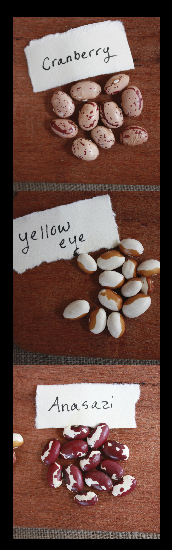
Yet that is just what is happening today. Using something called The Trade Relationship Intellectual Property Protection Agreement (TRIPP), Pioneer Hi-Bred, Monsanto, Novartis and a handful of other powerful agribusiness corporations have, in the last two decades, laid claim in the form of “patents” to thousands upon thousands ~ some say nearing 80% ~ of open seed varieties in the world today. These are seeds that throughout history farmers have traditionally saved and replanted to feed humanity. Yeah, that’s a Trip all right.
But here’s the best (read: worst) part. The battles being waged in the International Court of Justice in The Hague on the veracity of any “agreement” made between governments and corporations which can affect the human race’s ability to feed itself, even if they are won, will come too late to stop what is going on. By controlling and diminishing the use of wild seeds in third world countries, companies like Monsanto have already ensured the predominance of their own Genetically Modified products. It's hard to fathom the morality of a mindset that seeks to make money out of killing the essential nature of the seed to reproduce, but this is their endgame, make no mistake.
As Vandana succinctly explains ~ when one (wild seed) gives rise to many, there is no money to be made. But when one (GM seed) gives rise to nothing, there is a great deal of money to be made ~ when you control the rights to that seed. He who controls seeds, controls what is grown. A farmer that cannot use gathered seeds to regenerate crops is forced to buy whatever seeds are on the market. And whatever chemicals ~ which in the case of bioengineered seeds is a lot ~ needed to sustain them.

The writing is on the wall. In the Punjab region of India, a third world test case for the so called green revolution, when GT cotton ~ sold to farmers with the promise it would increase productivity tenfold ~ was planted, in one decade it all but destroyed the fecundity of a valley that had been naturally farmed for 5,000 years. 8 million farmers lost their livelihoods in that government assisted debacle, partly as the result of chemical dependence they could not afford. Where traditional bio diverse farming techniques once provided alternatives, when their monoculture crops failed, they left only depleted soils behind. If Vandana is to be believed, and believe her I do, 200,000 Indians farmers in this region committed suicide as a direct result of the GT cotton experiment. Many died by drinking Monsanto Round-Up as a final wake up call to the world.
Yet the world slumbers on.
If you want to wake up, there are still things you can do.
For a start, click on the links below. The link Food Democracy Now will let you voice your concern on a very important, time sensitive issue about GMO labeling. Stand Up for Your Right to Know! Food Democracy Now

All text and photos, Jil Hales (unless otherwise noted)
 All text and photos, Jil Hales (unless otherwise noted)
 (originally posted April 14, 2010)
Our first show in the new Studio will be photographer Wil Edwards’ Art of the Rind, a series of seemingly abstract, deeply saturated color images that if you didn’t know what they were, would put you more in mind of Salvador Dalí than smoky Gouda.
Going through Wil’s portfolio this week for a B&W series that will run concurrently in the restaurant, I happened upon some strong shots of animal carcasses he had not shown me before. Their formal elegance was reminiscent of the great photographer Atget. Wil captured the sinuous and quite beautiful line of the hollowed out bodies in a truthful way, one that did not objectify the animal so much as respectfully document its life. There is, after all, a long history of artists using the dead as models and inspiration: Michelangelo, da Vinci, Delacroix.
Only his mother liked them, Wil told me. Probably not a good idea to put them in the show. Did he like them? Yes, he did. A great deal. Still, he worried about offending people, turning them off.
I’m usually not drawn to art that takes its impetus in empty provocation, but showing these elegiac images isn't touting abattoir chic. Maybe its time we asked what's up with passionate omnivores who can romanticize the animals they eat while they are frolicking in the field, but still find methods of killing and butchering a squeamish subject. A reality check is important now and again, if you eat meat.

The majority of the Big Mac eating world is only dimly aware of the current national conversation about the dangers of factory farming which books like Jonathan Safran Foer's Eating Animals and films like Food First have rightly raised. Thats cool. It will come. After that, unless you refrain from eating animal proteins on moral grounds, knowing the animals you eat lived healthy lives and were killed humanely can make a consequential difference to your appetite and the way you choose to satisfy it. One of the most important goals of Fork & Shovel ~ the sustainable farmers and chefs collaborative we worked to get started two years ago~ was to make it easier for diners in our restaurants to get honest answers when they ask the question ~ “where does this food come from?”
The fact that ethical ranching represents less than 2% of the animal proteins served to the American public does not negate the paradigm we are supporting here in our food shed with groups like Fork & Shovel and our thriving Farmers Markets. Quite the opposite.
 If you haven't read Temple Grandin, or seen the TV film with Claire Danes about her, do one or the other, this is fascinating stuff. I'm of the opinion it helps to look death in the face and honor it, and animals give us that chance, in addition to feeding us. Most Americans can't stop gorging themselves on endless images that celebrate gratuitous violence but don't want to know how the animals they eat are being slaughtered. Major disconnect, no?
I take heart that the recent butchery class at Relish was such a huge success. More and more eaters (and it usually follows, good cooks) are beginning to accept the fact that you can't talk about following the food chain all the way back to the animal in a field without also accommodating the icky bits that happen in the abattoir.
On Friday when we arrived at the farm for the weekend we found we had no water in the house ~ our entire 200 gallon storage tank was empty. We did what we could to figure out the problem but had to switch locations for dinner we had planned with our friends, Tim and Karen, of Apple Farm fame, who live just down the road. We got to their place just as the sun was setting. As we pulled in I saw Sophia, their daughter, at the end of a row of blooming apple trees, setting off on her evening rounds to check on and feed the animals.
The Philo Apple Farm raises only enough animals to eat and serve to their guests. What Karen learned at the knee of her Mum, Sally, owner/chef of the original French Laundry, about food and where it comes from can't be put in a book (unless they choose to write one. Which I wish they would). When Charlie Palmer gifted us a whole 'leftover' pig from his Pigs n' Pinot a few years back,it was Karen I called to walk me through butchering it. I have never been squeamish, but even I was surprised by how much satisfaction I got from holding the animal and guiding the knife as it cut clean deep channels in the layers of flesh. That same feeling of connection came back when I viewed Wil's photographs this week.
 The light was fading as we tended to
Sophia’s horses and moved onto the
pigs, who are kept in pens that are moved around the orchards for grazing and fertilizing ~ the heart of bio dynamic farming. Animals have a crucial role to play in this family’s life that goes beyond feeding them. In the case of the magnificent Nordic draft horses Sophia is training ~ they are partners in her life’s journey. What occurred to me traipsing through the gloaming was how all of us ~ Geoff, Sophia and I, the pigs, goats, horses, dogs, & chickens ~ were all sharing the same evening. Hunger and the approaching dark had triggered in us similar concerns. Whether we were able to acknowledge it or not, we were in it together, dependent on each other, on what felt like a pretty profound level.
The light was fading as we tended to
Sophia’s horses and moved onto the
pigs, who are kept in pens that are moved around the orchards for grazing and fertilizing ~ the heart of bio dynamic farming. Animals have a crucial role to play in this family’s life that goes beyond feeding them. In the case of the magnificent Nordic draft horses Sophia is training ~ they are partners in her life’s journey. What occurred to me traipsing through the gloaming was how all of us ~ Geoff, Sophia and I, the pigs, goats, horses, dogs, & chickens ~ were all sharing the same evening. Hunger and the approaching dark had triggered in us similar concerns. Whether we were able to acknowledge it or not, we were in it together, dependent on each other, on what felt like a pretty profound level.

Before I ambled off to one of Tim’s perfect gin and tonics, I’m not sure, but I think I had a moment with the goat.
www.forkandshovel.com www.philoapplefarm.com www.templegrandin.com www.relishculinary.com
All text and photos, Jil Hales (unless otherwise noted)
 All text and photos, Jil Hales (unless otherwise noted)
Originally posted April 7, 2010)

Unless you are Jewish, you probably don't want to read about something that is going to make you feel guilty, but I urge you not to stop reading when you figure out where the column is heading this week.
Small Town America exists on two planes. There is the one defined by size alone, and then there is the one that cleaves to an old fashioned ideal ~ a Grover’s Corner of the mind where people on the street know your name and everyone shares a common language built on the love of a landscape and the necessities of survival in it. It’s a fact that as the national highway system begat the suburb, a worker bee construct designed in abstentia by corporate interests, it knocked the uniqueness out of the organic way towns once grew. If Americans can be said to share a language these days, it is not much different from city to town, and reads like the menu of a fast food restaurant. Yet once upon a time no matter what the ethnic and religious breakdown, folks worked alongside one another to achieve civic-minded goals. When was the last time you even heard the word civic?

In this world of boring places to live, Healdsburg stands out as an anomaly. Modern in all the best ways, our citizenry still encourages agrarian traditions that do not take the landscape for granted. I know from participating on the Planning Commission the past three years that many of us care deeply about what is built in our town; there is a passion to protect a diversity of interests in a fight against sameness, and a real commitment to see that those less fortunate have a place to live and food to eat. I love living here for all these reasons.
Even if we accept that self preservation will always rule our DNA, it’s important to admit that in shaking off the leadership role religion and strong community values once played in daily life, we have also lost the tithing gene that helped balance our world views and ultimately made us better people. I’m not talking about just being a good Samaritan, but being a volunteer. Giving something back to your community, not because it will enhance your business, but simply because it’s the right thing to do. Whether you need to sing a ‘do unto others’ hymn or Om your way through a ‘what goes around comes around’ mantra to get there, you need to get back there. We all need to get back there.
 Communities that don’t know one another on a personal level have no chance whatsoever surviving, much less flourishing, as unique entities that can protect their quality of life. The key is to mix with everyone in your community to build consensus, not stagnant with your own views until you can’t see the shit from the shinola. Watching congress “debate” the Health Care Initiative, the display of petty self serving stupid arguments that have stood in the place of reasoned dialogue in Washington should have made you sick ~ no matter who you think should ultimately pay for making you better.

On the Planning Commission I debate with people whom I often disagree with, but I’ve learned more from talking civilly about our disagreements than I have in conversation with friends whose political values I more or less share. OK we aren’t trying to solve national or international problems on the city council or the planning commission, but in a small but even more powerful way we are affecting the lives we live, side by side, every day. What I love about participating in a local body politic is that the only real litmus test you need to pass to participate is that you don’t put self-interest first above the good of the community.
But hey, forget the sense in all that. Maybe you don’t give a damn about the town the kids will someday inherit. On a singular karmic level there is enormous emotional return on tithing time ~ not money ~ to work amongst your neighbors ~ especially the very young and very old. It feels good. It costs nothing. I call those rare situations win win.

As many of us are busy planning our summer schedules right now it’s the perfect opportunity to dial in donating time to a community organization that needs you. Take the kids ~ in no time their schools will hopefully be giving them community service and with your help they will be old hands and get the better gigs. If you’re reading this and you live in Healdsburg I’m including a list of some truly worthy ongoing programs that could sorely use your help.
Wherever you live, know that your social services are under attack right now, which makes it the perfect time to step up, even~ no, especially~ if you’ve never volunteered for anything before. Just a few hours a week can make a world of difference to someone’s life. (Back to self-interest: someday that person could be you)
|
After School Program help kids K-5 with their homework at a crucial learning time in their lives. One hour a week between 4-5 at the Healdsburg Community Center at Foss Creek (formerly Foss Creek Elementary School) Contact: Sonia Drown Rec Manager for City of Healdsburg sdrown@ci.healdsburg.ca.us |
Healdsburg Senior Center Always needs Meals on Wheels drivers. They are also seeking individuals with talents they will teach the seniors and they will tailor a class around your skills Finally, they need Computer Tutors so seniors can learn enough basic skills to communicate with their grandkids! This is a lifeline. Taught at the Sr Center Computer Center Contact: Sonia Drown Rec Manager for City of Healdsburg sdrown@ci.healdsburg.ca.us
Adopt a Park: new program citywide. Incredibly, this is a new citywide program wherein you can customize your specific interests or talents to helping keep the parks humming. Running out of roses to prune? Come prune the city's! Contact: Matthew Thompson Parks Manager for City of Healdsburg Mthompson@ci.healdsburg.ca.us
Healdsburg Ridge ~ our new 150 acre open space at the edge of town needs volunteers for trail monitoring and special projects. A gorgeous place to spend time. WE ARE SO LUCKY TO HAVE THIS. Contact: Matthew Thompson Parks Manager for City of Healdsburg Mthompson@ci.healdsburg.ca.us
The Construction and Sustainability Academy (CASA) at Healdsburg High, is a green building program for high school students, is nearing completion on a fantastic classroom with everything in it. The entire project has been put together by volunteers but they need 3-4 more with painting experience. Contact: Ray Holly Rayholly@mac.com
The Healdsburg Food Pantry always needs hands to help stock and deliver, is now accepting fresh food from farmers. Mayor Woods reminds us that they also do Sunday Dinner at So many ways to contribute here that really make a difference. Contact: 1505 Healdsburg Ave. (707) 433 3663 info@healdsburgfoodpantry.org
All text and photos, Jil Hales (unless otherwise noted)
 All text and photos, Jil Hales (unless otherwise noted)
(originally posted March 31, 2010)
 The fine line we’ve straddled with respect to wine since we opened Barndiva has been one of world class vs. local class. You’re shaking your head ~ there doesn’t have to be a difference between the two, does there? Until three months ago I would have said, unequivocally, yes. Creating a list with world class wines, whether a Grand Cru Domaine Leroy Chambertin from France or a Grace Family Cabernet from just over the hill, wines that appeal to special occasions or unlimited budgets, and confidently integrating them with lovable mutts, great wines without a pedigree that can be had at affordable prices, takes more than chutzpah. Even more to the point, a high end list of the caliber we have now set out to build, needs to work ~ to feel right ~ with a menu like Barndiva’s that does everything it can to lift the total experience of dining without a commensurate smack of affectation. Call us greedy: what Ryan does for food we want to do with wine. We want it all.
 Our first wine list five years ago was an amalgam of high hopes and wistful beginners luck. That double bind again: we wanted a list to be proud of, but one that our patrons could enjoy on a regular basis without breaking the bank. Our good friend Craig Strattman (who owns the farm to table Restaurant Patrona in Ukiah) introduced us to Walter Inman, then the talent behind the wine program at John Ash. Walter, a savvy and bitingly funny guy, took pity on our lack of local contacts and with his guidance we fashioned an opening list that first summer which had 36 wines and 18 sparkling by the glass, and a 3,000 bottle cellar. We were the new kids in town and the list was good enough to get us featured in some wonderful wine magazines from all over the world. Still. It would be years of listening to what patrons ~ both tourists and local ~ wanted before we began to understand the forces at play behind a truly great list.
 From the outset the vintners who became regular patrons let us know they too were interested in great wine that wasn’t necessarily from around here; that a balance between foreign and local would be most welcome. This was good news, as we’d heard that a strong foreign presence on a wine list had sunk more than one new restaurant in town. It also got easier to source great local vintages with long waiting lists as we integrated fully into life here in Healdsburg.
We love where we are going with our programs. Please come in to give us try!
All text and photos, Jil Hales (unless otherwise noted)
 All text and photos, Jil Hales (unless otherwise noted)
(originally posted march 27, 2010)
 For someone who’s pretty much obsessed with taste ~ the food and drink varieties ~
ironically that’s not the taste I’m asked about all the time. More than any single dish people have enjoyed in the restaurant, or single object they’ve purchased in the shop, it's been the overall aesthetic of Barndiva and the Studio ~ the way everything is put together in both buildings ~ that has generated the greatest force field of interest over the years.
For someone who’s pretty much obsessed with taste ~ the food and drink varieties ~
ironically that’s not the taste I’m asked about all the time. More than any single dish people have enjoyed in the restaurant, or single object they’ve purchased in the shop, it's been the overall aesthetic of Barndiva and the Studio ~ the way everything is put together in both buildings ~ that has generated the greatest force field of interest over the years.
With respect to the shop, we’ve even had clients who buy a whole mixed media wall to get what they call “the look,” or “the effect.” I know I have a talent for design, but the overwhelming response to the mise en place of our lives has lead me to suspect that something else is operating here beyond expansive admiration. A clue can be found in the oft heard refrain from those customers who don’t just look around and take a picture of Artists & Farmers like it's some Disneyland of Design, but actually step up & buy something: “I love it,” they will tell us, “now I just have to find a place to put it."
It's probably good to remember that we’ve only been at beautifying our surrounds for a few hundred years, though we’ve been foraging for a few thousand and are packrats by extension of the same primordial pull. Why then, is it so hard to know how arrange our surroundings so they truly reflect what we call our ‘taste,’ that material and very social manifestation we hope speaks to who we are ~ and where we hope we are heading?
 Barndiva and The Studio define a very personal taste aesthetic, and it’s the personal part writ large that most people seem to desperately want. Unfortunately, it's something you won’t find in the dozens of home and design magazines who ply their trade by generating thousands upon thousands of images of (we are told) coveted homes filled with dream rooms of stunning art and fabulous furniture. We’ve all been trained to lust after the things we see in those rooms, which is fine ~ I love my Côte Sur ~ but at the end of the day they all beg a question they can’t answer for you. Namely, who would you be if you lived in those beautiful, seemingly perfect rooms? The answer has to start with: who are you in your rooms now?
The editors of Elle Décor or Dwell don’t know you ~ nor, really, does that decorator you hired (if you have the dosh or the inclination) that came so highly recommended. The talented ones have their own proven sense of what works together in a room, and general rules of thumb on how to arrange furniture and art to make rooms larger or cozier ~ all good ~ but trust me when I tell you ~ having worked on the periphery of this industry for years ~ that at the end of the day rooms that sing do so because whomever lives in them composed their own song. Great taste comes from writing (and rewriting) your own lyrics over time, and altering the melody so it stays relevant.
K2 asked me the other day, as we were waxing on where to place things in the new space we are creating in The Studio, what objects I still had around me from when I was very young. The question took me by surprise because as it turned out the answer was….not a lot. My Kertesz photograph lives wherever I sleep most nights; as does the small oil of two figures on a blue bed that Frane gave me the weekend I met Geoffrey; I still have the huge antique Guerlain cologne bottles I inherited from the first Tex Feldman, the sleepy doll I never cared much for until Beatrice crushed its face dusting it on a windowsill when I was 5, but besides photographs of my family at various stages of our lives, nothing around me is much more than ten years old. The truth is that even before the fire which wiped out most of what I’d collected in life, I didn’t hold onto things with the avidity of someone who seems to have a lot of beautiful, lived in things around her.
The fire taught me many things, the primary lesson being that with the exception of your personal words and images, everything else in a material life can be replaced. By letting go of things you once found charming, or amusing, you make room for the next step in your own definition of those attributes. There should not be a divide between the things you buy to impress the world and the things you collect because they speak to you on a personal level. Sorry. If the things you want to surround yourself with are stupid or silly, own it (that may not be a bad thing anyway). If they are made badly or the product of a calculated corporate mindset that does not value human labor or the environment, ask yourself why you have them around. Things, no matter how small, should add to the daily conversation you’re having with life (or should be having).
 As the new gallery has taken shape over the past week ~ 14 hour days and sleep riddled with questions ~ but so much fun ~ I’ve realized that the one talent I really have isn’t what to pick up and put into my world, it's when to let go. Years of looking critically at art, architecture, literature and cinema informs my choices when I put things together that don’t at first seem to have anything in common. But at the end of the day, no matter what passion you’ve followed, even if it's light years away from a proclivity for art and design, you still live with things, pick them up and put them down on something, use them, sit in them, sleep in them, eat off them, look at them at odd hours of the day when you are really thinking about something else. If you are what you eat (and I believe that is profoundly true) you are also a reflection of your surroundings, like it or not. They can elevate the experience of life, or weigh it down.
Thankfully, the choices really are yours. And the good news is that you can only get better and better at curating your own life when you start paying attention.
As the new gallery has taken shape over the past week ~ 14 hour days and sleep riddled with questions ~ but so much fun ~ I’ve realized that the one talent I really have isn’t what to pick up and put into my world, it's when to let go. Years of looking critically at art, architecture, literature and cinema informs my choices when I put things together that don’t at first seem to have anything in common. But at the end of the day, no matter what passion you’ve followed, even if it's light years away from a proclivity for art and design, you still live with things, pick them up and put them down on something, use them, sit in them, sleep in them, eat off them, look at them at odd hours of the day when you are really thinking about something else. If you are what you eat (and I believe that is profoundly true) you are also a reflection of your surroundings, like it or not. They can elevate the experience of life, or weigh it down.
Thankfully, the choices really are yours. And the good news is that you can only get better and better at curating your own life when you start paying attention.
 As things will happen in this cosmic joke we call life, a few days ago I received an inquiry from the New York Times Style Magazine to feature The Studio in the upcoming issue. To be in The Style Magazine ~ which only comes out a few times a year~ is one of the coolest compliments. The fact the call came the week we had just closed and dismantled Artists & Farmers might, for the faint hearted, seemed like the ultimate WTF.
 The thing is, I’m so excited about what we are about to become that I managed to find a shrug and a classic 'whatever' about the timing. They will come around again or they won’t ~ whatever the case, they will find us in a our usual state of creative flux, a wonderful place that defines everything we do and keeps it all interesting for me, K2 & Dane here in the Studio and Geoff, Lukka, Ryan, Tracy, Tommy, Spencer and the rest of the wonderful gang at Barndiva who have thrown in with us.
All text and photos, Jil Hales (unless otherwise noted)
(originally posted March 17, 2010)
Time to tell you how we’re going to fill up our dance card this spring:
Next week we will paper over the windows at Artists & Farmers for a major systemic Spring cleaning. When we re-open, as Studio Barndiva, we will have lightened our load of small pieces, allowing us to deepen our connection to painting and sculpture and giving us enough room to use the gallery for live events. In April we’ll move outdoors and “finish” the gardens. In May we’ll throw a party to celebrate with Friends of Barndiva. We wouldn’t be able to do any of this without your support.
 For the past three years Artists & Farmers has been privileged to represent some of the finest craftsmen and women in the world, many of whom had no previous representation in this country. That will not change. But our strength as a family, and as three individuals, has always been to follow our interests, and our instincts, even in the crazy world of food, drink, art and design, even as this recession rocks us all from side to side, up and down. You don’t get on a roller coaster unless you crave, at some level, thrill for the ride. And while uncontrollable forces can make you dizzy (or sick to your stomach) they can also make your heart beat a little faster, your creative juices start to flow. We feel a flow coming on.
Most of you know the history of the studio up to now. My friend Bonnie Z is fond of putting on what she thinks of as her Bella Lugosi voice (which in reality sounds more like one of her crazier chickens) to intone ‘first there was 3.... then there was 2… then there was…’ but as we’ve run through partners, eventually inheriting the entire space, we’ve used the time to study this extraordinary property. Building the herb beds and throwing down Sonoma gold on what was just a parking lot was a no-brainer, but we’ve never lost sight of the fact that this land, before the old auto-body shop was built on it, once housed Healdsburg’s first opera house ~ can you imagine the cultural optimism this town had two hundred years ago to have tried to create that scene when you still tied up horses at the front door?
We’re not advancing the notion that a frontier opera house is what’s missing in town (though we certainly wouldn’t mind one) merely that a little frontier spirit is never amiss, especially now. Our MO, the same one that built Barndiva ~ is to have fun, work hard, and build something that doesn’t exist yet in town. We want to be proud of the product we’re selling, whether it's an invitation for you to eat and drink in one of our spaces, entrust your wedding day with us, or buy an object of significance in the gallery and take it home.
So here’s our thinking:
- There are wonderful galleries in town, but there remains a need for art + performance.
- There is not yet a great space to dance after a wedding, then stumble safely back to your bed whether it's in a hotel or your own home.
- There is no small venue, no beautiful room, where a string quartet can play on a summer eve while you sip.
- The town could use a salon ~ the 18th century definition of one (look it up) where lively intellectual conversation in the fields of arts and letters and, yes, politics, are discussed with wit and verve (remember those things?) over a good cocktail.
 Finally, if all that weren’t enough (we will never be accused of doing things in half measures) we’d like to advance the notion that coffee is not the only hot drink we long for throughout the day (sorry Phil). I drink tea a lot ~ not least for it's suspected medicinal effects ~ black in the morning, white in the middle of the day, a lightly caffeinated green to get me to cocktail hour, after which my momentum seems almost pre~ordained. But I wasn’t always a tea drinker, even after many years in London. My friend Todd at Rishi never gave up on me, sending small elegant black sachets with every Barndiva order, with intriguing names like Iron Maiden and Ancient Moonlight White. The idea for an occasional tea bar came to me one afternoon during a very long walk across Paris. I must have passed two hundred great bars ~ you know the ones, zinc or marble counter, Godard pinball sounds in the background ~ where for 3 euro’s I could have walked up to the bar, slung my foot over the brass rail and had a moment to myself over a quick espresso. Jeez, even the Queen of England calls it a quick cuppa~ why can’t you get a perfect cup of tea, made and served properly (as befits a drink that goes back 2,000 years) the same way? In the new gallery space we’ll be working with our friends at Rishi, ~ who we believe source the finest organic, fair trade teas in the world, to redress this inequity.

Things will change slowly until the end of May when wedding dinners start beneath the arbors in the new Studio gardens. We invite you to come in and share the transition period with us. If you are on this list you’ll naturally be invited to our Salon Evenings and all of our opening night parties for art shows, the first of which will be Art of the Rind, with photographer Wil Edwards, working with Cowgirl Creamery, in June. In July the crazy talented (and just plain crazy) Frane of worldwide children’s book fame will be in residence. Frane is working big for the first time in years ~ this is fabulous work, work to make you dream, and we are so proud we will be representing her. If we play our cards right in Carmel next week, Susan Keifer will follow Frane in August.
But hey, listen, If you don’t collect art, have no interest in raising high the roof beams at a wedding, are uncomfortable with the idea of Salon Evenings, and would never be caught dead alone at a bar with a cup of rare tea, you still have something to look forward to after our upcoming zeitgeist at 237 Center Street…For YOU, dear reader, there is the great news that as we shift our wedding celebrations to the Studio, Barndiva will be no longer have to close to the public on Saturdays!
Gotcha.
All text and photos, Jil Hales (unless otherwise noted)
(originally posted March 10, 2010) Sunday March 7th (the last day of Wine Barrel Tasting weekend) 12-12:30 pm Dawn Elise & Ari's Baby Shower brings the first day of Spring Co-hosts Lukka Feldman and Joy Sterling
 6:30- 11pm
Oscar Dinner Party: Homage a Julia Child
6:30- 11pm
Oscar Dinner Party: Homage a Julia Child


All text and photos, Jil Hales (unless otherwise noted)